

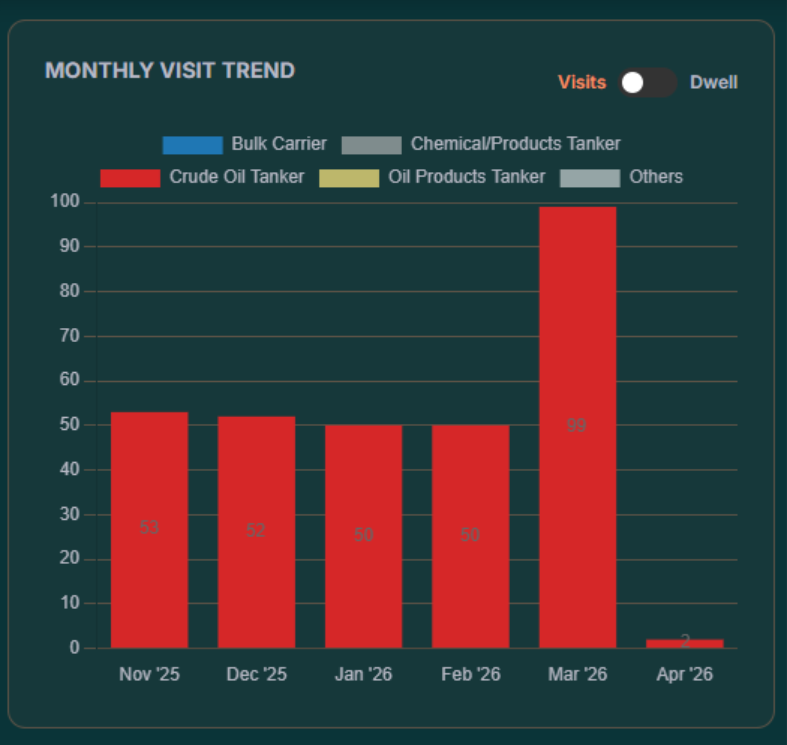
Crude tanker activity at Yanbu, Saudi Arabia’s primary Red Sea export terminal, increased significantly in March, with 97 tanker calls recorded, compared with around 50 per month in January and February. This marks a clear deviation from recent baseline levels and suggests increased utilisation of Red Sea export routes as an alternative to the Strait of Hormuz.
Pole Star Global data also shows that 852 total vessel calls were recorded at the port between January and March 2026, providing broader context for overall activity levels.
Observed Activity Trends
Yanbu, located on Saudi Arabia’s west coast, functions as a key outlet for crude exports via the Red Sea.
Tanker activity remained relatively stable between November and February, with monthly crude tanker calls holding close to the 50 mark. The increase recorded in March therefore represents a clear deviation from this pattern rather than routine variation.
Vessel type data indicates that crude oil tankers account for the largest share of traffic at the port, supporting the view that the increase is directly linked to crude export flows.
Drivers of Increased Yanbu Traffic
Yanbu is connected to eastern Saudi oil fields via the East-West pipeline, enabling crude to be transported across the kingdom without transiting the Gulf.
The Strait of Hormuz handles a significant share of global seaborne oil flows and remains a key maritime chokepoint.
Ongoing geopolitical tensions and elevated security risks continue to influence routing decisions. Increased utilisation of Red Sea export infrastructure may reflect efforts to reduce exposure to potential disruption by shifting volumes westward.
Implications for Crude Oil Flows
The increase in tanker calls at Yanbu suggests a potential adjustment in Saudi export strategy, with greater use of Red Sea routes.
If sustained, this shift could affect tanker traffic distribution across the region and alter exposure to key maritime risk areas. Changes in routing at this scale can also influence voyage distances, freight rates, and operational risk.
Further data, including vessel destination patterns and activity levels in April, will be important in assessing whether this represents a temporary increase or a developing trend.
Outlook
The change in activity at Yanbu highlights how export routing can respond to evolving geopolitical conditions.
Monitoring port level activity will remain important for understanding how crude oil flows adjust in response to regional risk dynamics.