
By Saleem Khan, Chief Data & Analytics Officer – Pole Star Global
Since 5 March, Pole Star Global has tracked 3,396 vessels in and around the Strait of Hormuz. Roughly 1 in 15 of them – 231 ships – are exhibiting suspicious positional anomalies. “Jumping” implausible distances, going briefly “ghosted,” or reappearing in patterns consistent with GPS and AIS interference. This is no longer a story about isolated glitches; it’s a systematic, geographically clustered distortion of reality at sea.
At the same time, we are seeing a near-total cessation of commercial traffic through the Strait, and some ships leaving the region are broadcasting extraordinary “destinations” such as “China Owner and All Crew”, turning what should be a navigational field into a live political message: don’t shoot, we’re not your target.
Beyond the chokepoint, about 540 oil tankers carrying an estimated 314 million barrels are currently at sea with no fixed destination, listed simply as “awaiting orders” – effectively a $30 billion floating oil exchange waiting for a safe route and a safe buyer.
Pole Star Global fuses AIS, satellite detections, ownership, and behavioural analytics to help governments, insurers, and shipping companies separate malfunction from manipulation. Our data offers an unusually granular view into how conflict, coercion, and digital deception are reshaping global trade in real time – and where the next fractures might appear.
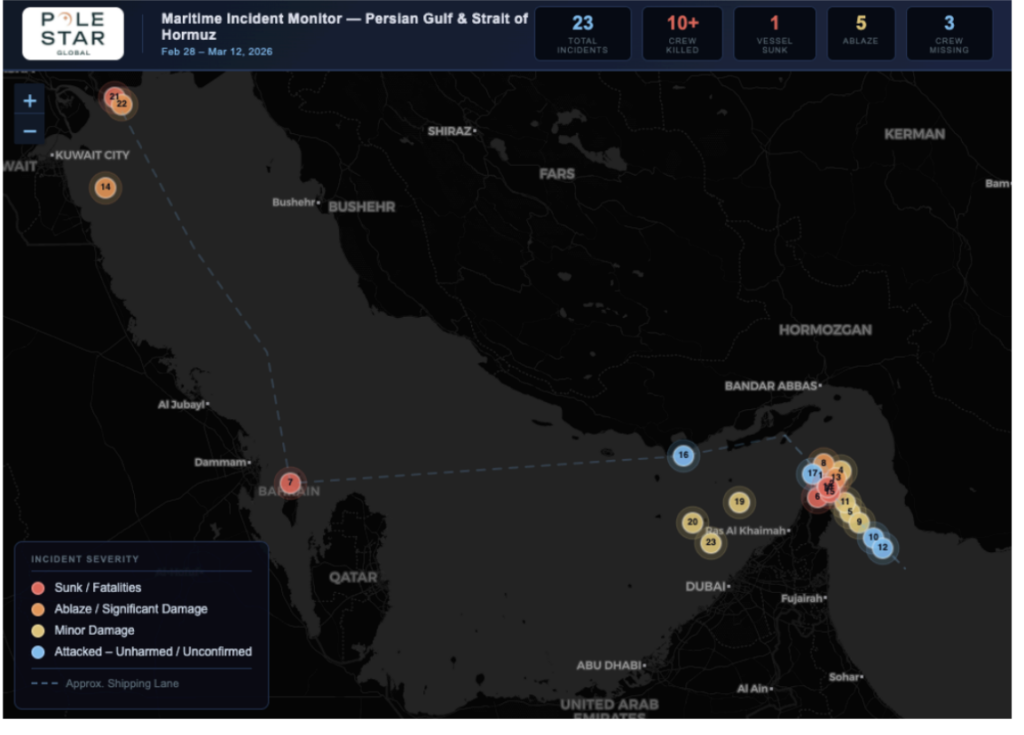
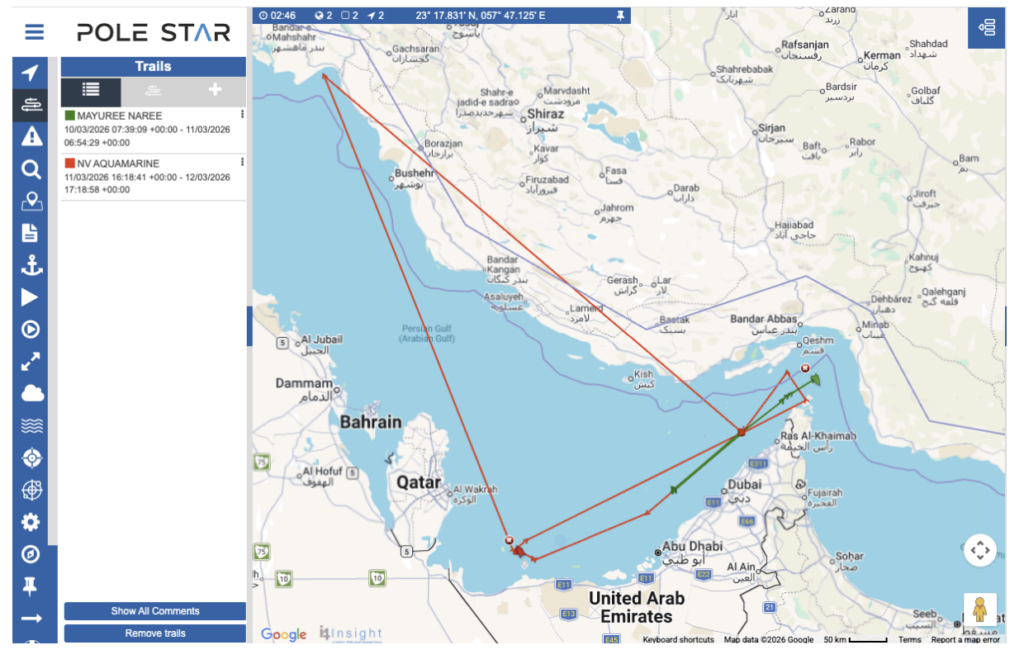
The image below shows intentional AIS manipulation by a vessel called the NV Aquamarine (in red trails). This vessel was travelling at an astounding 102 knots (188 km/hr) from the Strait to the Iran/Iraq border. This is impossible for a tanker that has a capacity to carry 350,000 barrels of oil worth $35M at current spot rates.
As the full picture is still emerging, AIS interference is just one part of a larger story.