

Feature 1: Additional Entity Screening During Vessel Tracking
What’s new:
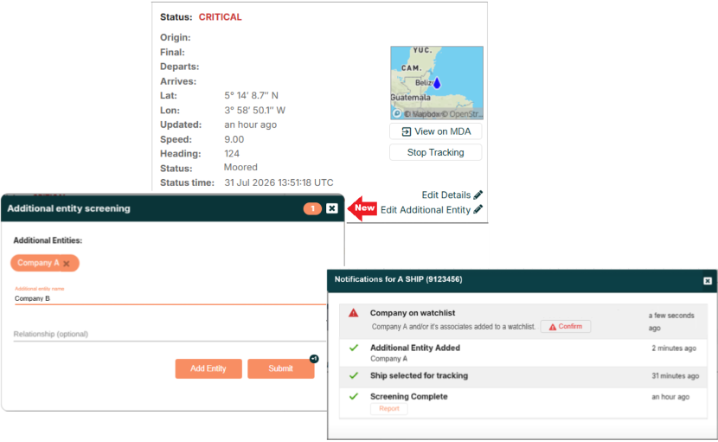
PurpleTRAC now lets compliance and operations teams add specific entities during vessel tracking, as well as during screening. Entities linked to a vessel transaction that are not already listed as the vessel’s owners, managers, or operators can be added without leaving the workflow. This helps teams complete due diligence faster, reduce context switching, and maintain stronger audit trails.
Teams can also remove additional entities previously added during vessel tracking or screening. If an entity linked to a vessel transaction no longer needs to be monitored, it can be removed directly within the same workflow, keeping the entity list accurate and relevant without manual cleanup outside the platform.
Why it matters
- Add additional entities during vessel tracking.
- Remove previously added entities during vessel tracking.
- Receive notifications when additional entities are added or removed.
- Capture each change in the Trade Report audit trail.
Feature 2: Since Date for Zone Alerts
What’s new:
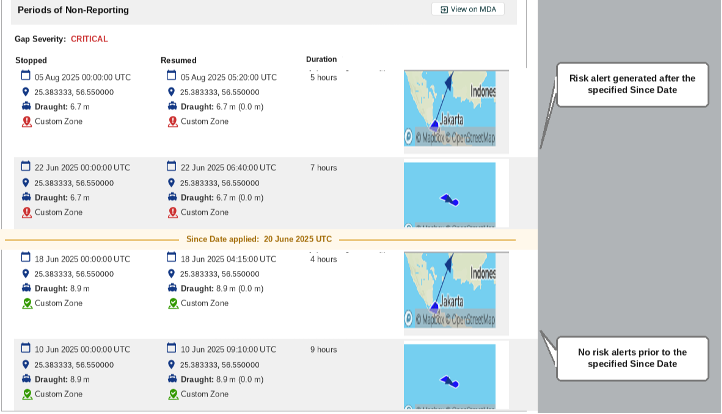
PurpleTRAC now lets compliance and operations teams set a Since Date for each zone configuration, so vessel screening only flags zone events that occurred after the selected date. This keeps alerts focused on the current monitoring window, reduces noise from historical activity outside the risk period, and improves audit-trail accuracy.
Why it matters
- Set a Since Date for each zone configuration.
- Choose which event types the Since Date applies to, including gaps, STS pairings, and positional discrepancies.
- Prevent zone events before the Since Date from triggering severity alerts in the API, UI, and PDF outputs.
Feature 3: New Dual-Use Goods Regulations
What’s new:
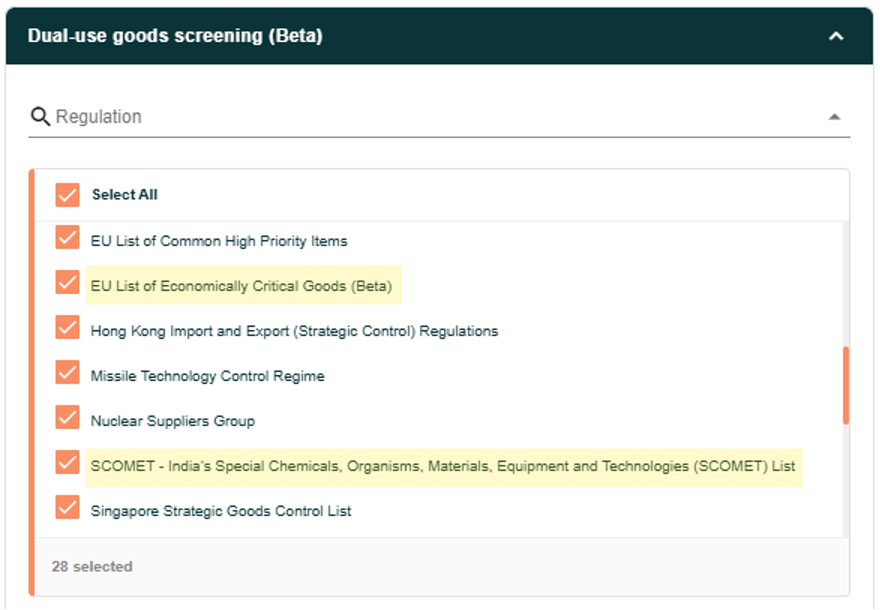
PurpleTRAC now includes two additional dual-use goods regulations:
- SCOMET — India’s Special Chemicals, Organisms, Materials, Equipment and Technologies list.
- EU List of Economically Critical Goods.
Why it matters
- Screen shipments and vessels against India’s SCOMET controls.
- Screen shipments and vessels against the EU’s emerging Economically Critical Goods framework.
- Access both lists alongside PurpleTRAC’s existing dual-use goods lists in the same compliance database.
- Help customers keep pace with evolving export-control requirements without adding a separate screening process.
Podium (Shipping & Offshore)
Feature 1: Distributor-Enabled SSAS Test Mode & Mock Alerts Across Account Hierarchy
What’s new :
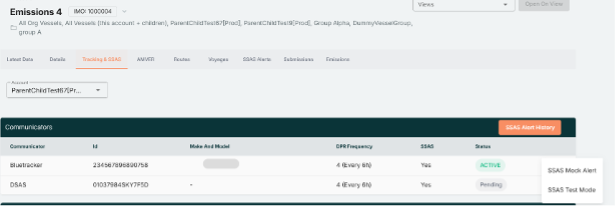
Distributers can now enable SSAS Test Mode and trigger Mock SSAS Alerts for their child account directly from the Tracking & SSAS tab.
Why it matters
- This feature gives distributors greater control and visibility over SSAS testing across their account hierarchy, without requiring them to switch between parent, child, or grandchild accounts using impersonation.
- Simplifies SSAS testing: Distributors can initiate SSAS Test Mode and Mock Alerts for vessels managed by their child and grandchild accounts directly from Podium.
Feature 2: Route Deviation Alerts
What’s new :
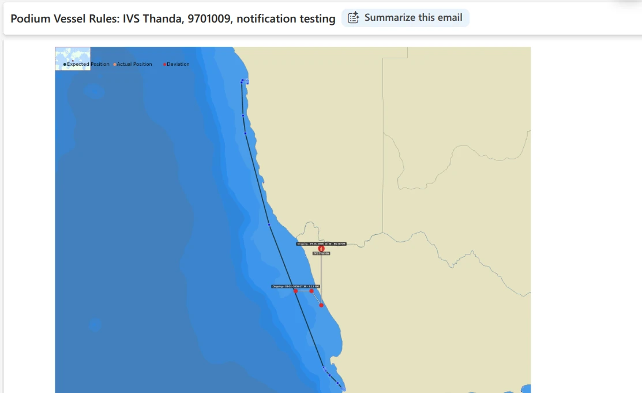
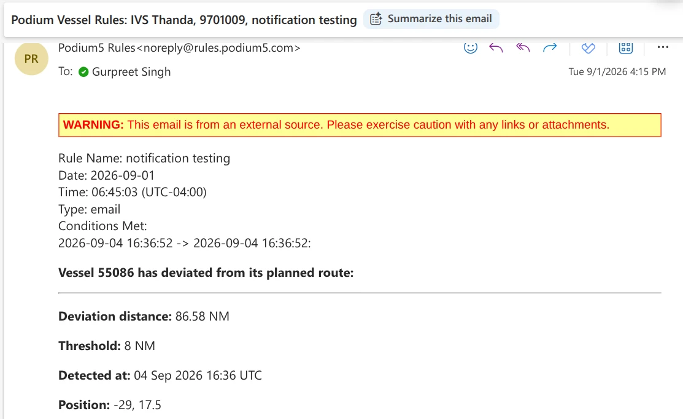
Route Deviation Alerts – a new capability within Podium’s Vessel Rules & Email Notifications module that automatically alerts fleet operators when a vessel strays from its planned route.
Route Deviation Alerts in Podium are powered by the Route Deviation Service, a platform-level microservice built as a shared, reusable capability across Polestar products.
Why it matters:
- Monitoring a fleet across open waters at scale is hard. When a vessel goes off-route, delayed awareness can mean Increased fuel costs, Charter party violations, Safety and regulatory risks. Until now, spotting an off-route vessel meant actively watching the map – not scalable for large fleets.
- Operators are notified the moment a vessel exceeds their configured distance threshold
- Every alert includes the deviation distance and a map snapshot – the context needed to act immediately
- No manual monitoring required
Feature 3- Fleet Card UI Refresh
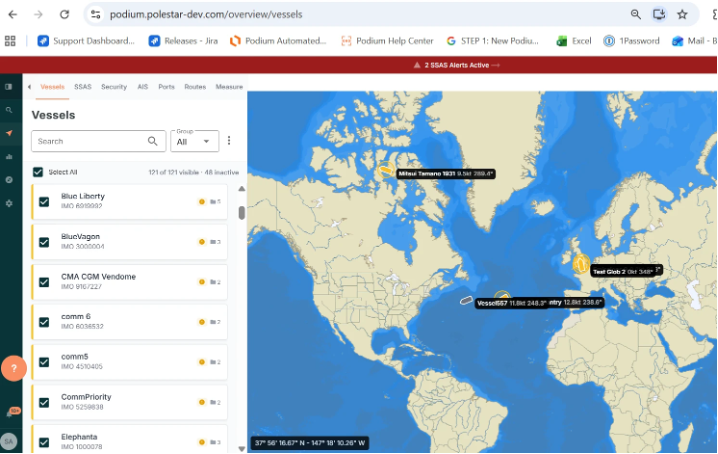
The Fleet page has been redesigned with a cleaner and more compact vessel card layout, allowing users to view more vessels within the available screen space while maintaining quick access to key operational information.
What’s New
- Compact vessel cards that display more vessels within the viewport, reducing the need for scrolling.
- Vertical vessel colour strip replaces the previous coloured card background, making vessel colours easier to identify while improving readability.
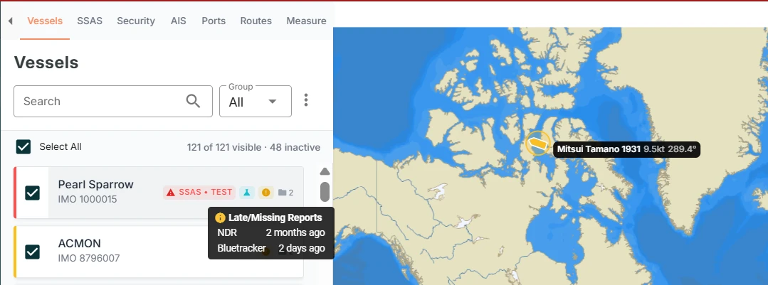
- Redesigned status indicators for alerts and late/missing reports, providing a cleaner and more consistent presentation.
- Group count is now displayed on each vessel card, with tooltips showing the groups a vessel belongs to.
- Late/Missing Report indicators now display the number of outstanding reports, with hover tooltips providing additional details such as report type and age.
Why it matters:
- Improved readability and information hierarchy.
- Faster scanning of large fleets.
- Better visibility of operational status without increasing visual clutter.
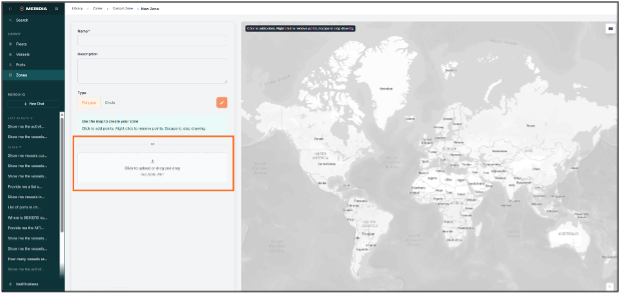
Feature 1: Upload GeoJSON or WKT files to create custom zones
What’s new
Custom zone file uploads: You can now upload GeoJSON and WKT files when creating or editing custom zones, making zone setup faster and easier.
Why it matters:
Simplified workflow: Upload existing spatial files instead of manually drawing zones or re-entering data.
Greater precision: Bring existing geographic data standards, including GeoJSON and WKT, directly into the platform.
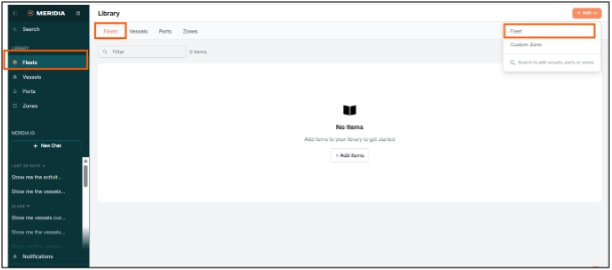
Feature 2: Create, edit, update, and delete static fleets
What’s new
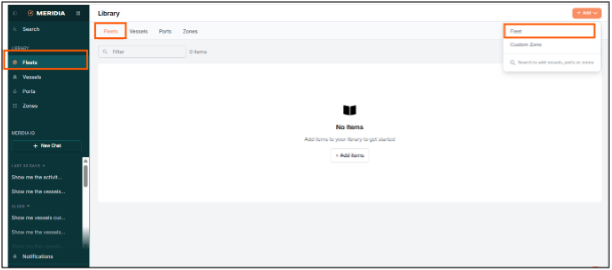
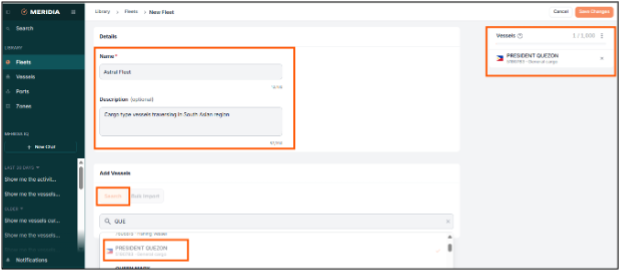
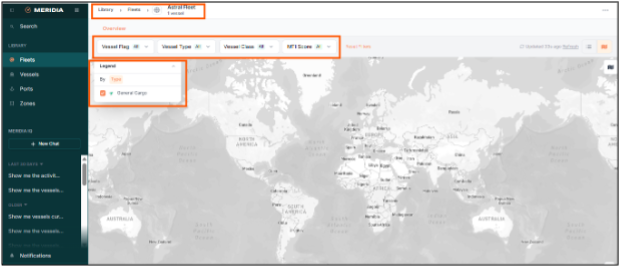
Customers can now create and manage custom vessel fleets directly in the Fleet Management UI. The feature supports several core fleet-management actions:
- Group vessels into logical fleets.
- Add or remove vessels individually.
- Maintain fleet metadata, including names and descriptions.
Why it matters
Fleet stakeholders need full creation, view, update, and delete control, so fleet lists stay accurate as vessels move in, change status, or leave active monitoring. This reduces manual coordination, keeps fleet ownership and descriptions current, and gives teams a reliable foundation for fleet-based activities.
Maritime Transparency Index (MTI)
MTI API
What’s new
The Maritime Transparency Index (MTI) API is now available, providing programmatic access to MTI data and risk assessments for integration into customer workflows, compliance processes, and maritime intelligence platforms.
The API enables authorized users to retrieve structured information across the key dimensions of the MTI framework, including:
- Vessel Score : historical and structural indicators such as vessel age, ownership changes, flag transitions, sanctions history, deficiencies, and detentions.
- Reporting Score : the reliability and consistency of AIS positional reporting, including reporting gaps, frequency, duration, and potential spoofing indicators.
- Voyage Score : voyage-level behaviours and anomalies, including port-call patterns, time in port, ship-to-ship activity, slow steaming, and unexplained delays.
- Emission Score indicators relating to a vessel’s environmental footprint, including vessel characteristics, engine configuration, and fuel usage.
By exposing MTI information through an API, customers can incorporate maritime transparency and risk signals directly into their existing systems and operational processes.
Why it matters:
Maritime risk assessment is most effective when relevant intelligence is available at the point where decisions are made. The MTI API helps customers move from manual checks and disconnected workflows to repeatable, data-driven risk assessment.
With API access, customers can:
- Integrate MTI data into existing platforms such as compliance tools, vessel-screening systems, risk dashboards, and operational workflows.
- Support faster due diligence by making vessel transparency and risk indicators available alongside other internal and external data.
- Standardize risk assessment across teams by applying a consistent framework to vessel, reporting, voyage, and emissions-related indicators.
- Identify elevated-risk activity earlier by incorporating MTI signals into monitoring, alerting, and review processes.
- Improve auditability by embedding risk checks into defined workflows rather than relying solely on ad hoc, manual reviews.
- Scale maritime oversight across larger vessel populations and higher volumes of voyages without increasing manual effort at the same rate.
The MTI API supports a more connected approach to maritime risk management, helping organizations identify potential exposure earlier, focus investigations where they matter most, and make more informed decisions across the maritime value chain.